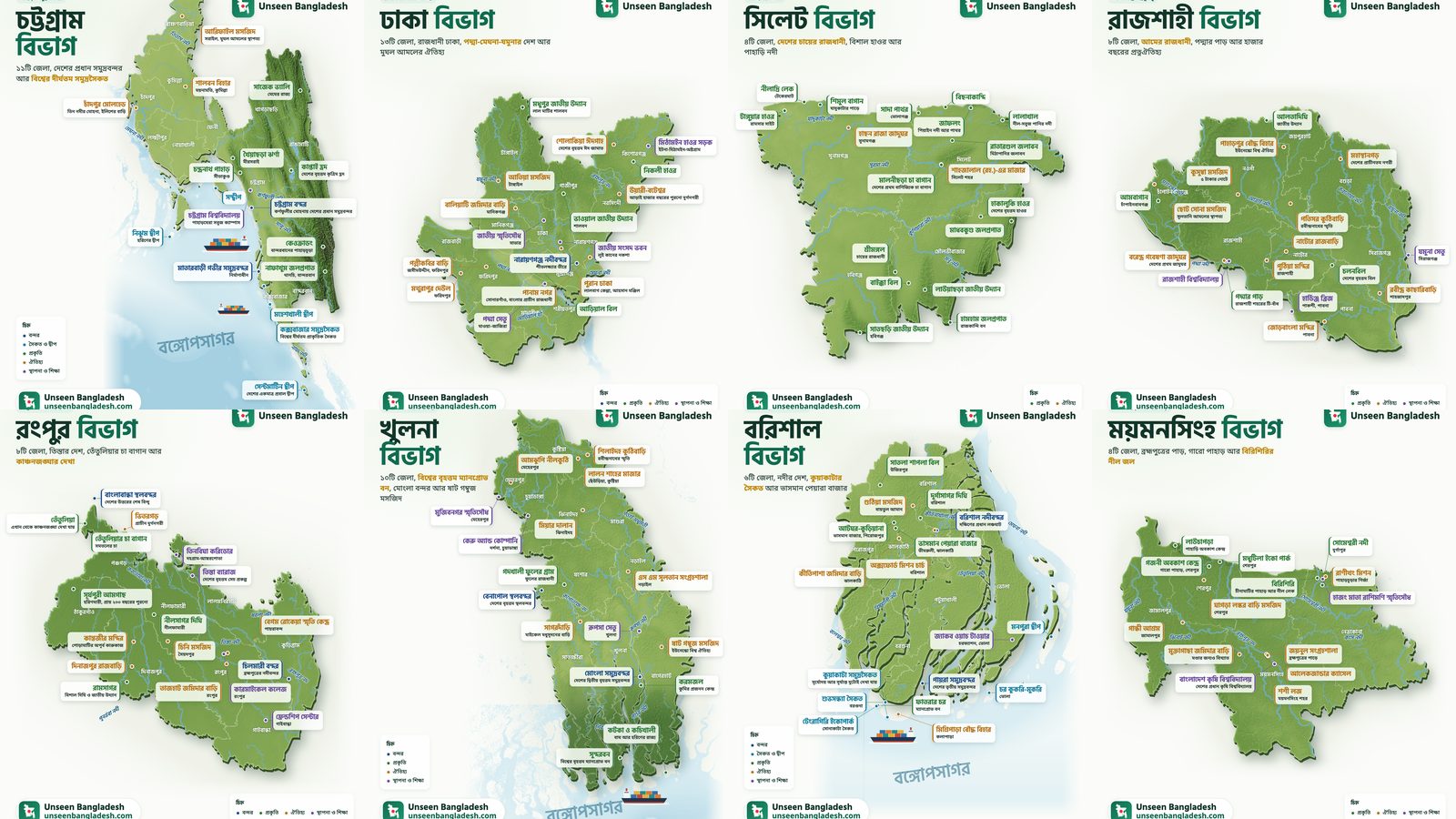
Bangladesh as Clay Toys: 7 Divisional Cities and Their Icons at a Glance
From Chattogram's City Gate to Sylhet's Keane Bridge, Dhaka's parliament to Khulna's Sixty Dome Mosque: the best-known landmarks of seven divisional cities as clay-style 3D scenes, with the story behind each one.

- Style
- 3D clay-style dioramas
- Cities
- 7 (Mymensingh coming soon)
- In each scene
- 4–6 of the city's landmarks
- Made by
- Unseen Bangladesh
- Share
- On our Facebook page
Trip ticket
Every city has a few sights that tell you instantly where you are: Chattogram's City Gate, Sylhet's Keane Bridge, Dhaka's parliament building. We turned those landmarks into little clay-toy 3D scenes, one tile for each divisional city, like a model of the city sitting on a table. This article brings the seven scenes together, with what's in each one and why.
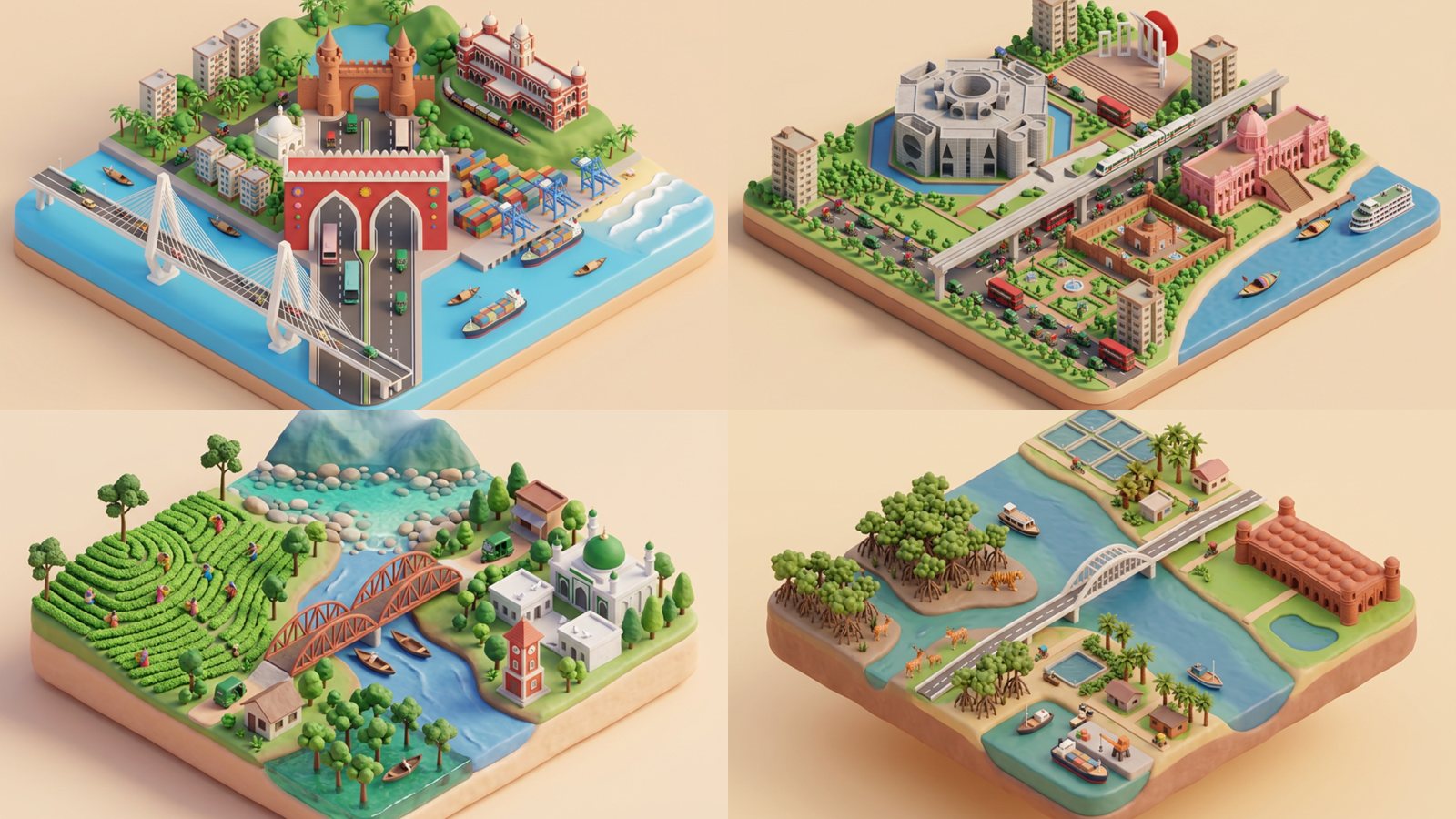
Chattogram: the port, the hills and the City Gate
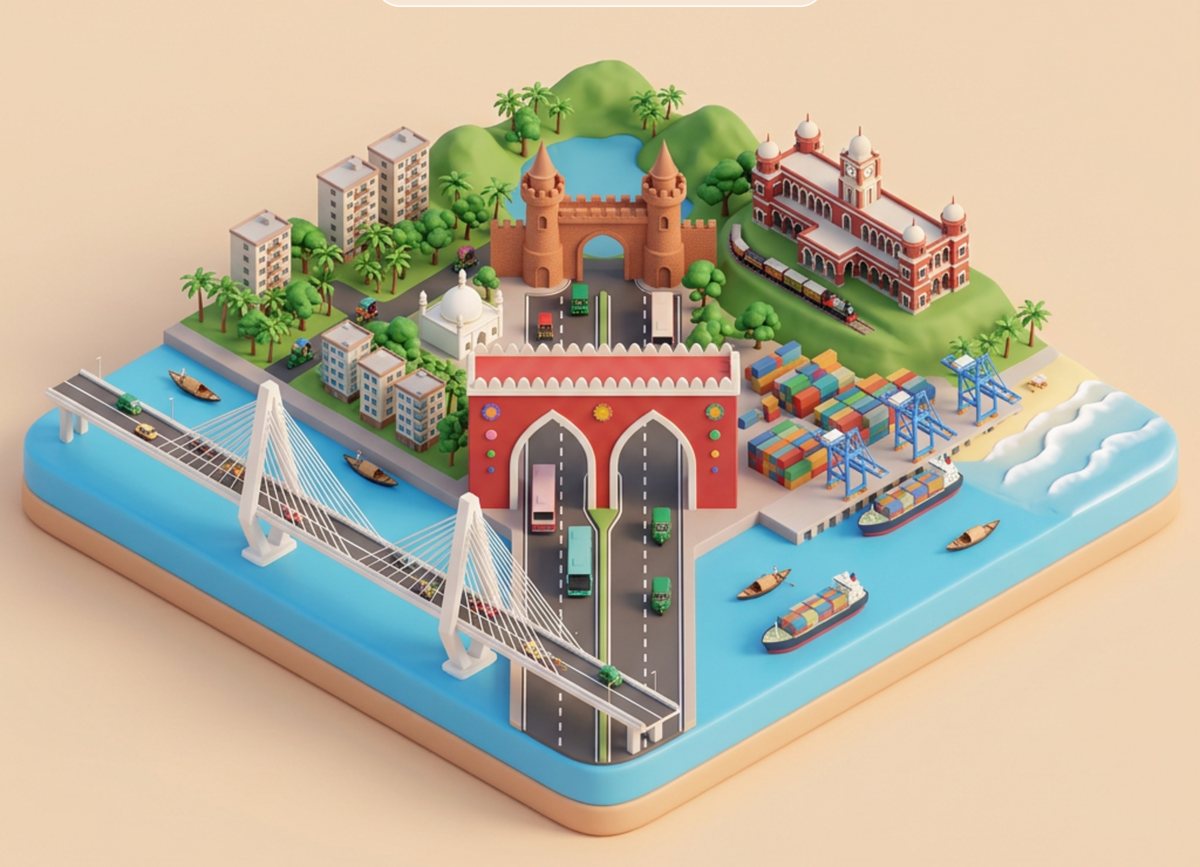
- Chattogram City Gate: the red twin-arched gateway where the Dhaka–Chattogram highway enters the city; one of Chattogram's best-known symbols.
- Chattogram Port: containers, cranes and ships at the mouth of the Karnaphuli, the country's main seaport.
- The bridge over the Karnaphuli: linking the city with south Chattogram.
- Hills and a lake: the green hills and red-brick gateway at the top recall Foy's Lake and the city's hilly side.
- Sea waves: a sandy beach in one corner, like Patenga.
Dhaka: parliament, Ahsan Manzil and the metro
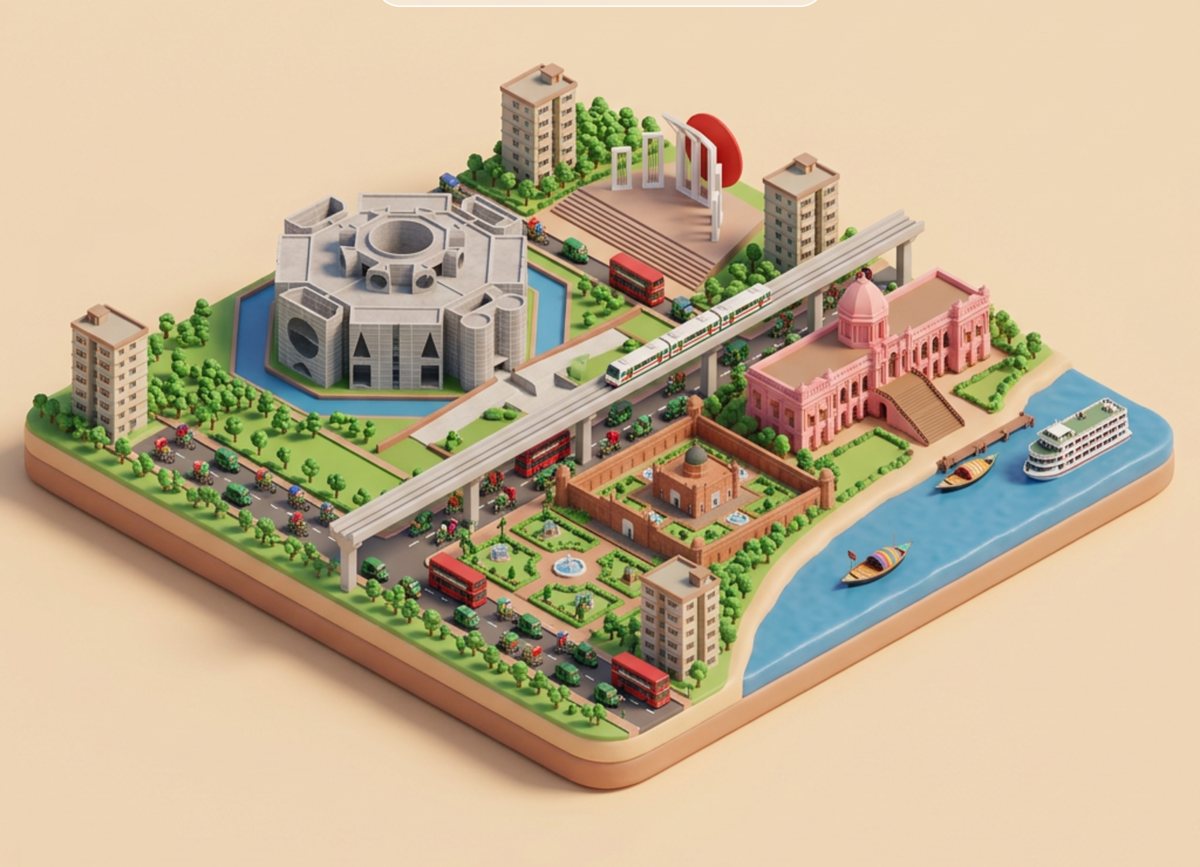
- National Parliament House: Louis Kahn's grey geometric building surrounded by water; Dhaka's most famous piece of architecture.
- Central Shaheed Minar: the red sun and white pillars honouring the language martyrs of 1952.
- Ahsan Manzil: the pink palace of Dhaka's Nawabs on the Buriganga, with its wide front steps.
- Lalbagh Fort: the red-walled Mughal fort and its garden.
- The metro and double-deckers: new Dhaka, with the metro on its elevated line and red double-decker buses below.
- The Buriganga and its launches: the river boats that leave Sadarghat for the south.
Sylhet: tea gardens, Keane Bridge and hill rivers
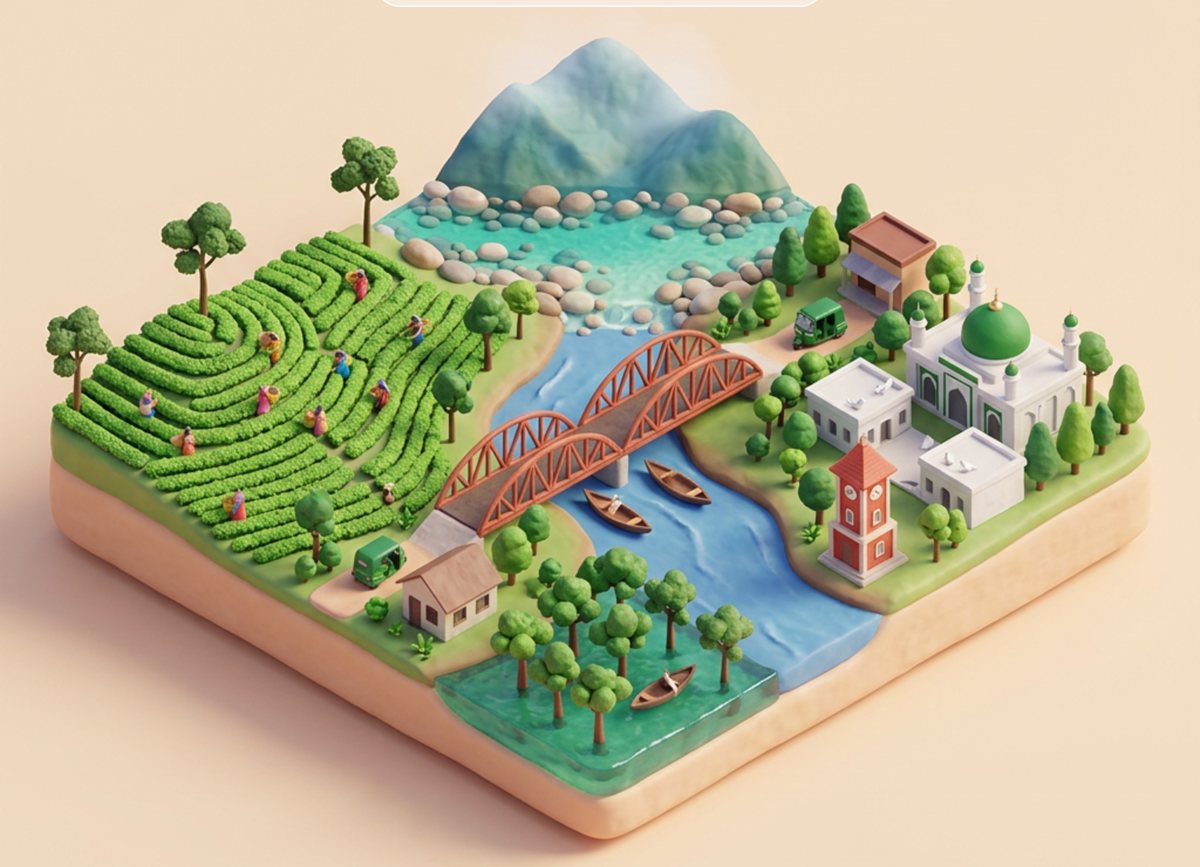
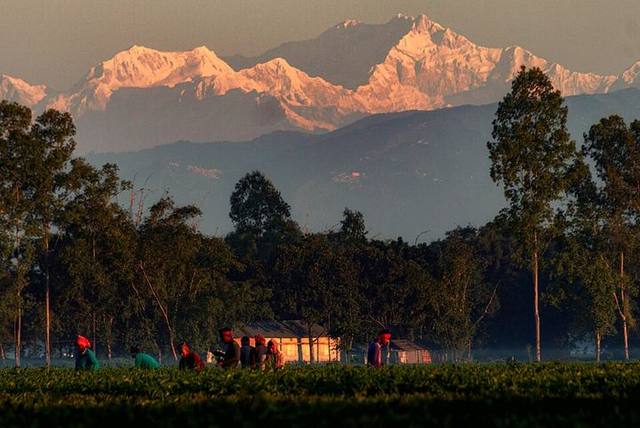
- Tea gardens: rows of tea bushes on the hillsides and tea pickers at work; the region's best-known image.
- Keane Bridge: the red iron bridge over the Surma, built in the 1930s; the symbol of Sylhet city.
- Ali Amjad's Clock: the red clock tower on the bank of the Surma, from the 19th century.
- Shrine of Shah Jalal: the white mosque with a green dome, one of the country's best-known shrines.
- Stones and clear water: the rocky river coming down from the hills recalls Jaflong and Sada Pathor.
Rajshahi: terracotta temples, mangoes and the Padma
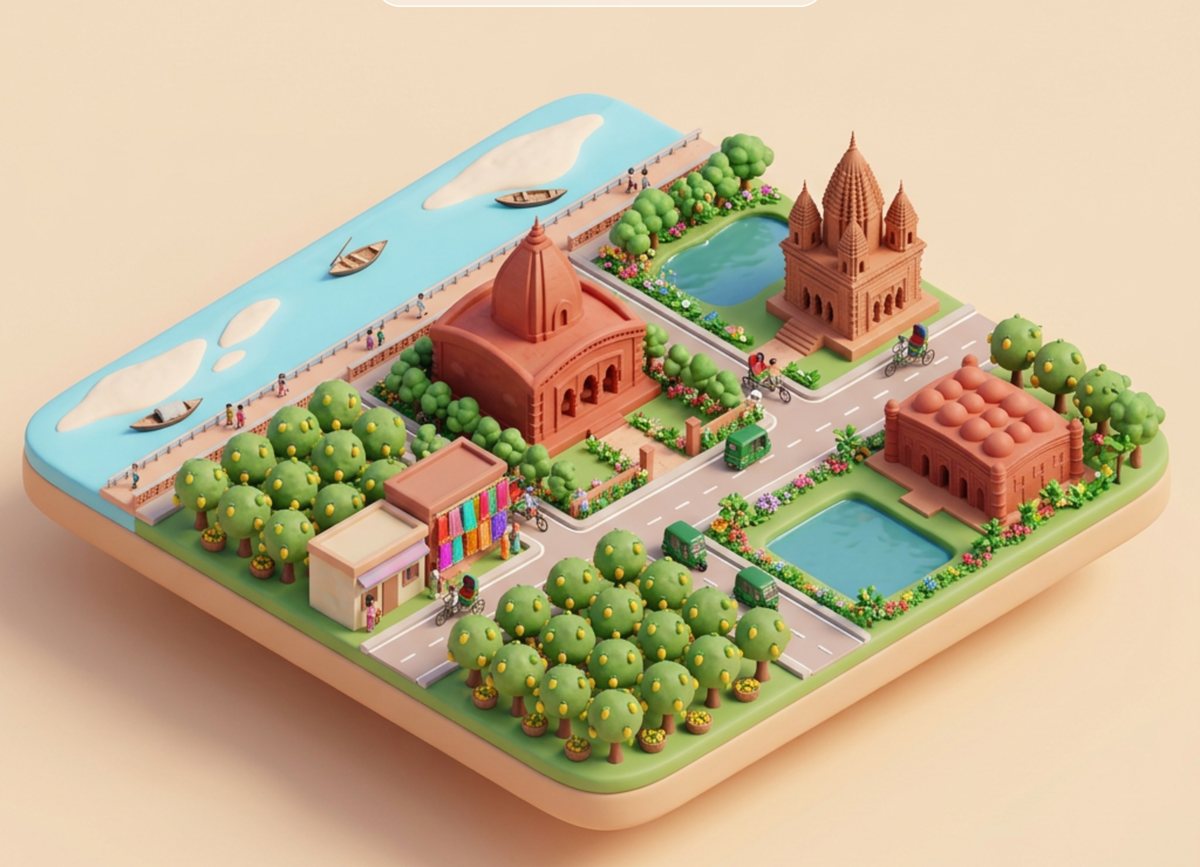
- The Puthia temples: red temples with terracotta decoration, modelled on the Puthia temple complex.
- Mango orchards: Rajshahi and Chapainawabganj mean mangoes, so mango trees fill much of the scene.
- Silk: a stall of colourful cloth, a nod to Rajshahi silk.
- The Padma: the river flowing past the city, with boats and sandbanks.
- Tanks and ponds: a touch of the old tanks of the Barind region.
Rangpur: Tajhat, the Teesta and shatranji
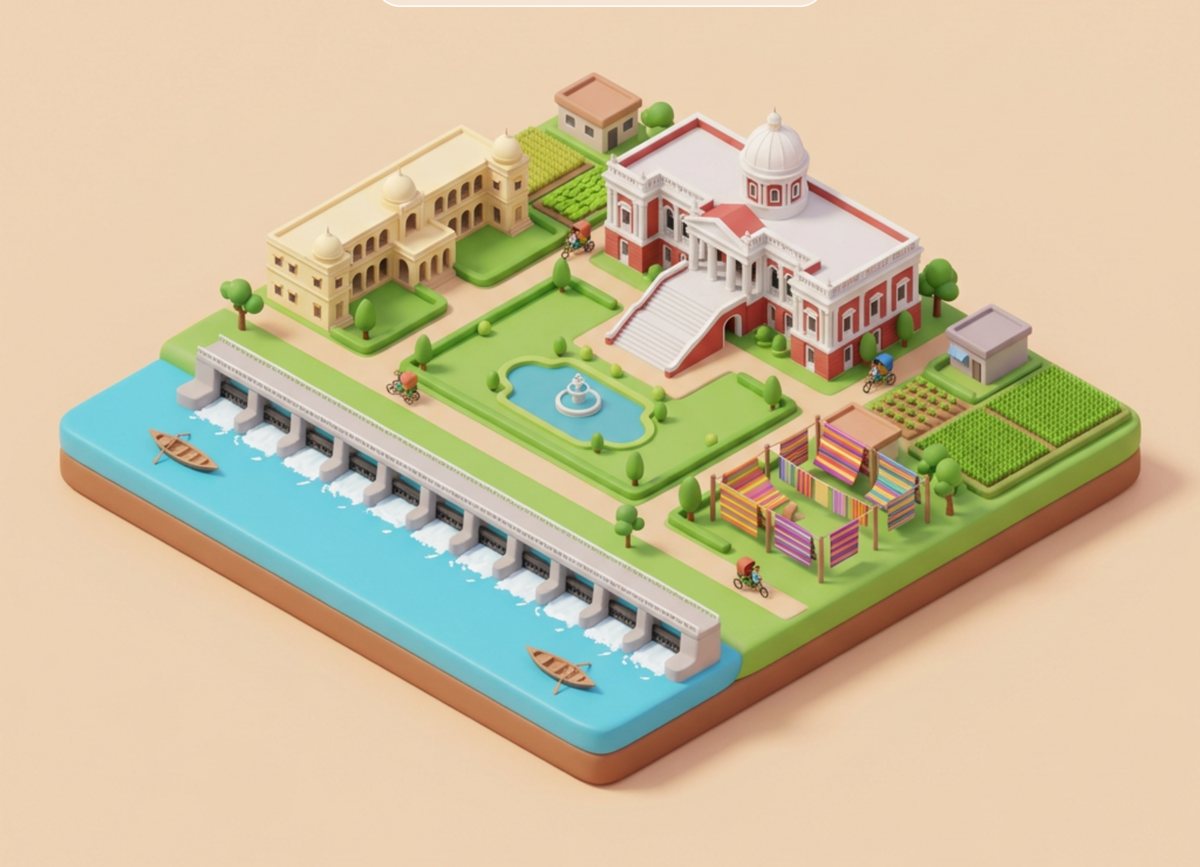
- Tajhat Zamindar Bari: the white and red palace with a central dome and a grand staircase; Rangpur's best-known historic building.
- Teesta Barrage: a barrage with rows of sluice gates across the river, the country's largest irrigation project.
- Shatranji: colourful hand-woven rugs, Rangpur's traditional craft.
- Fields and gardens: the green farmland of the north.
Khulna: the Sundarbans, the Rupsha and the Sixty Dome Mosque
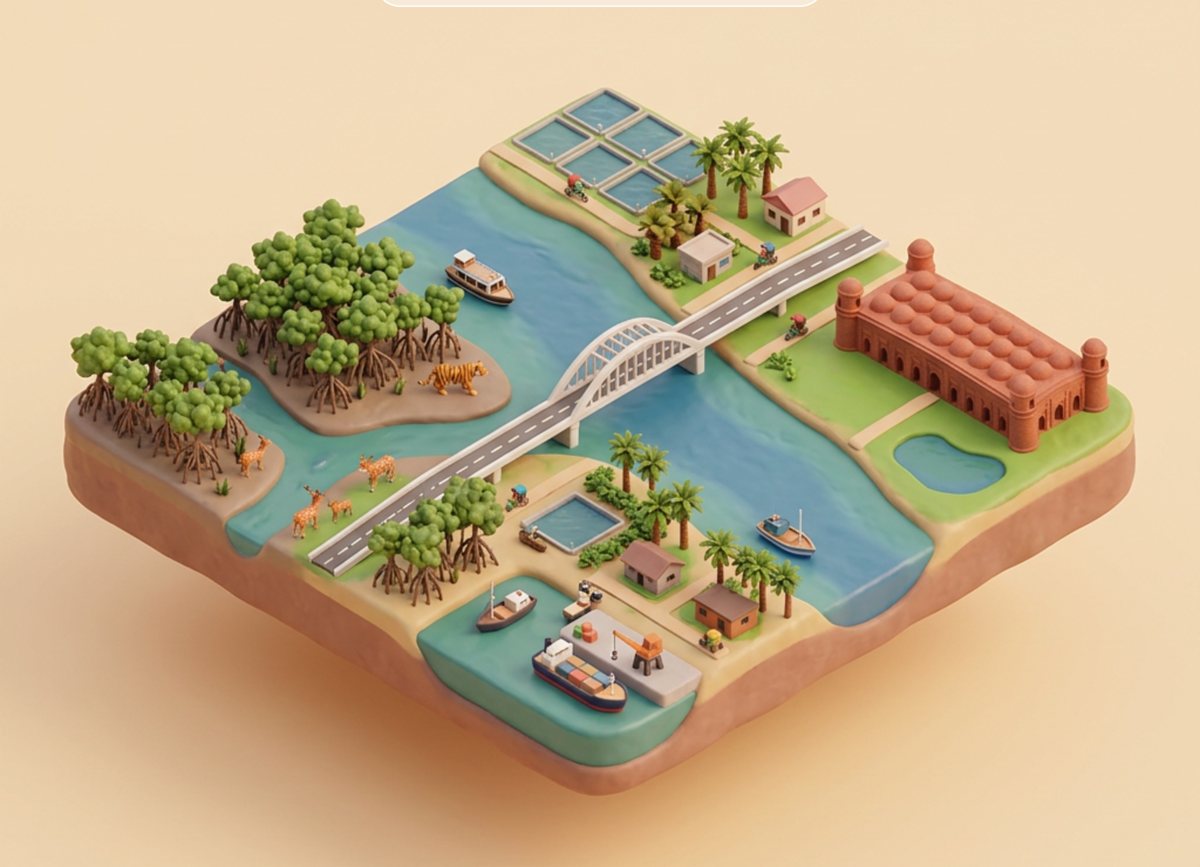
- The Sundarbans: mangroves with breathing roots, a tiger and deer; the world's largest mangrove forest.
- Rupsha Bridge: the white arched bridge over the Rupsha, the gateway to Khulna city.
- Sixty Dome Mosque: rows of red-brick domes, built by Khan Jahan Ali in the 15th century, a UNESCO World Heritage Site.
- Shrimp farms: rows of square ponds; the region's shrimp farming.
- Mongla Port: ships and a jetty, a hint of the country's second-largest seaport.
Barishal: launches, the floating market and Durgasagar
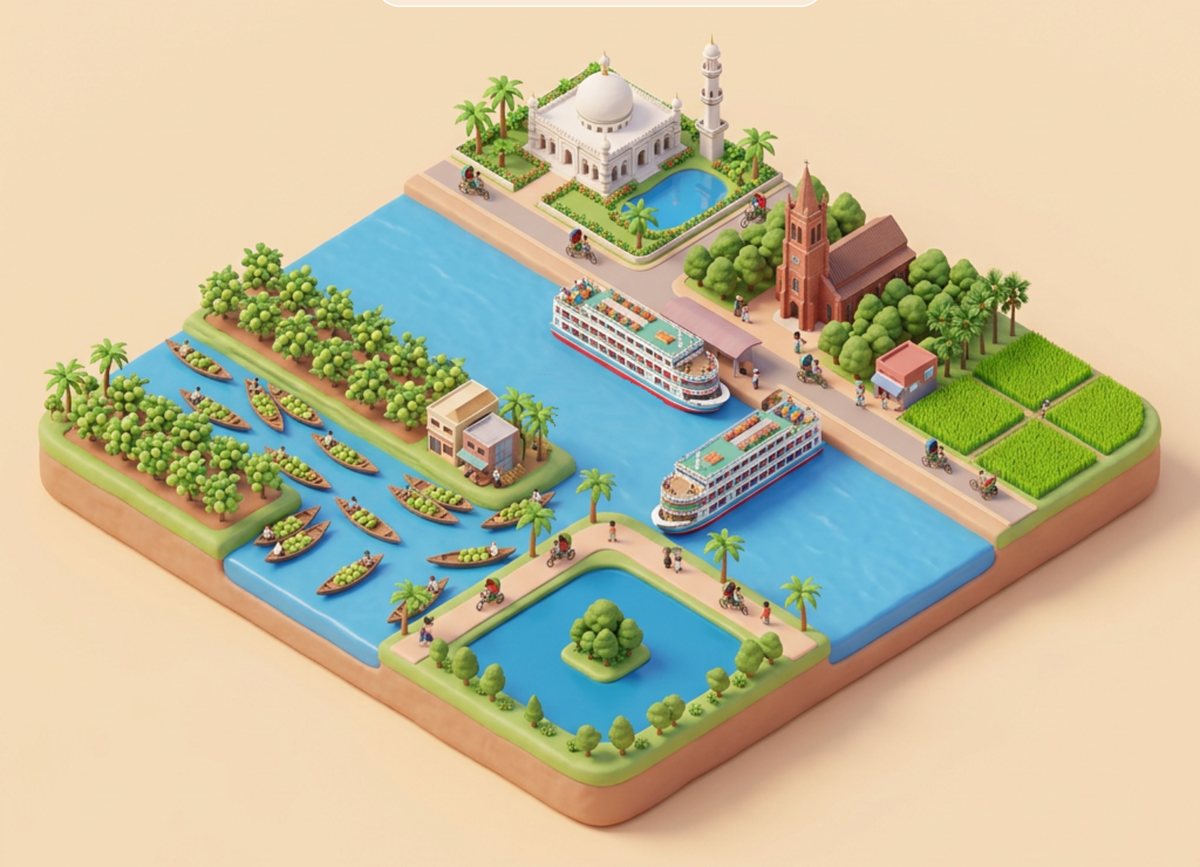
- Double-decker launches: the big boats of the Dhaka–Barishal river route, the city's most familiar sight.
- The floating guava market: boats full of guavas in a canal, like Bhimruli and Atghar in Jhalokati and Pirojpur.
- Guthia Mosque: the Baitul Aman mosque with its white dome and tall minaret.
- Oxford Mission Church: the old red-brick church, part of Barishal's heritage.
- Durgasagar: the huge square tank with an island in the middle.
- Guava orchards and rice fields: the green south.
Mymensingh: coming soon
The eighth scene, Mymensingh, is in the works: the Brahmaputra, Shoshi Lodge, the Garo hills and the blue water of Birishiri. It will be added here as soon as it's ready.
Seeing and sharing the scenes
- The full image of each city is going up on our Facebook page; share your own city's and tag your friends.
- To find the places in the scenes, with routes and costs, search for the city on the Explore page.
- Think a landmark is missing from your city? Tell us and we'll try to add it in the next version.
Questions and answers
Are these real photos?
No, they're 3D clay-style artworks. The buildings and places are modelled on the real landmarks but simplified like toys, so sizes and details aren't exact.
When will Mymensingh's scene come out?
It's being made. It will be added to this article and our Facebook page as soon as it's ready.
Will you make one for my district?
For now we're working on the eight divisional cities. Tell us which district you'd like to see in a comment on our Facebook page.
Can I use these images in my own posts?
You can share them with the Unseen Bangladesh name and logo. Please don't edit them, crop the logo off or post them as your own.
See it on the map, plan your trip
Look up the places, routes and costs, then put your own trip together.