 Unseen Bangladesh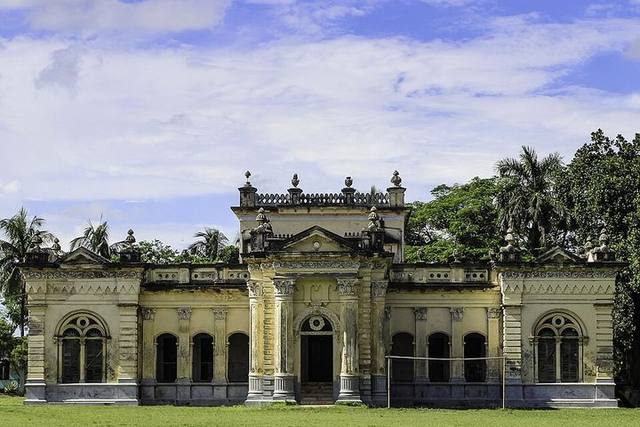
Natore District · Rajshahi Division · নাটোর রাজবাড়ি
Natore Rajbari travel guide
Rani Bhabani's palace; surrounded by ponds, temples and gardens.
At a glance
- Founded
- Early 18th century (Ramjiban Roy)
- Area
- About 120 acres
- Famous for
- Rani Bhabani (1716–1795)
- Buildings
- Palaces of the senior and junior branches, temples, ponds
History and details
In the early 18th century, with the favour of Nawab Murshid Quli Khan of Murshidabad, Ramjiban Roy became owner of the huge Natore zamindari and moved his capital to Natore. Rani Bhabani, wife of his adopted son Ramkanta, ran the estate for a long time after her husband's death.
Rani Bhabani was known as 'Ardha-Bangeshwari' for her able administration, generosity and the temples, roads and ponds she built; her zamindari covered a huge part of Bengal. History records her support for Siraj ud-Daulah before the Battle of Plassey.
The rajbari complex has the palaces of the senior and junior branches, the Shyamsundar Temple, the Anandamoyi Kalibari and several ponds. It is now a tourist spot called the 'Rani Bhabani Central Park'.
Things to do
- Walk round the senior branch's palace and pond
- See the rajbari's temples
- Eat Natore's kachagolla
How to get to Natore Rajbari
Close to Natore town.
Natore is about 220 km from Dhaka; the journey takes 4.5–5 hours.
- 🚌 By bus: Rajshahi/Natore-bound buses from Gabtoli, fare ৳550–700.
- 🚆 By train: Rajshahi-bound trains to Natore station, fare ৳300–900.
Where to stay
The district town has basic and mid-range hotels (roughly ৳800–2,500). Government circuit houses and dak bungalows can be used with permission.
What to eat
Natore's kachagolla (the most famous)
Good to know
- Don't forget to buy Natore's kachagolla
- Can be done the same day as Uttara Ganabhaban
More to see nearby
- Uttara Ganabhaban (3 km)
- Chalan Beel (20 km)
- Puthia Temple Complex (20 km)
More places to visit in Natore district
- Uttara Ganabhaban (Dighapatia Rajbari) — The palace of the Dighapatia rajas; a garden of rare trees and a museum.
- Chalan Beel — The country's biggest beel; a vast sheet of water in the monsoon, birds in winter.